ServicesLighting Installation
Lighting Installation in River Oaks
We plan and install lighting that suits the room and costs less to run: recessed and pendant fixtures, under-cabinet strips, outdoor lights and the dimmers and sensors that control them. Every fixture is wired to code, set level and finished cleanly against your ceiling or wall.
Better Light, Lower Running Costs
Good lighting is mostly about placement and control. A room with one bright fixture in the middle and dark corners feels smaller and gets more lamps plugged in over time. We look at how you use each space, then place light where you read, cook or walk, and put it on switches and dimmers that let you use only what you need.
The efficiency side is real but practical. LED fixtures draw a fraction of the power of older incandescent and halogen lamps, and they give off far less heat. In a North Texas summer, a kitchen full of hot halogen cans adds load your air conditioning has to remove. Swapping them for sealed LED fixtures helps on both counts.
If your project grows into new circuits or opened walls, we can fold it into our remodel and addition wiring work so it is planned once.
What Our Lighting Work Covers
Recessed lighting
We lay out cans on a spacing that lights the room evenly, cut clean openings and use airtight, insulation-contact rated housings under attic space. That keeps conditioned air from leaking into the attic through each light.
Pendants and chandeliers
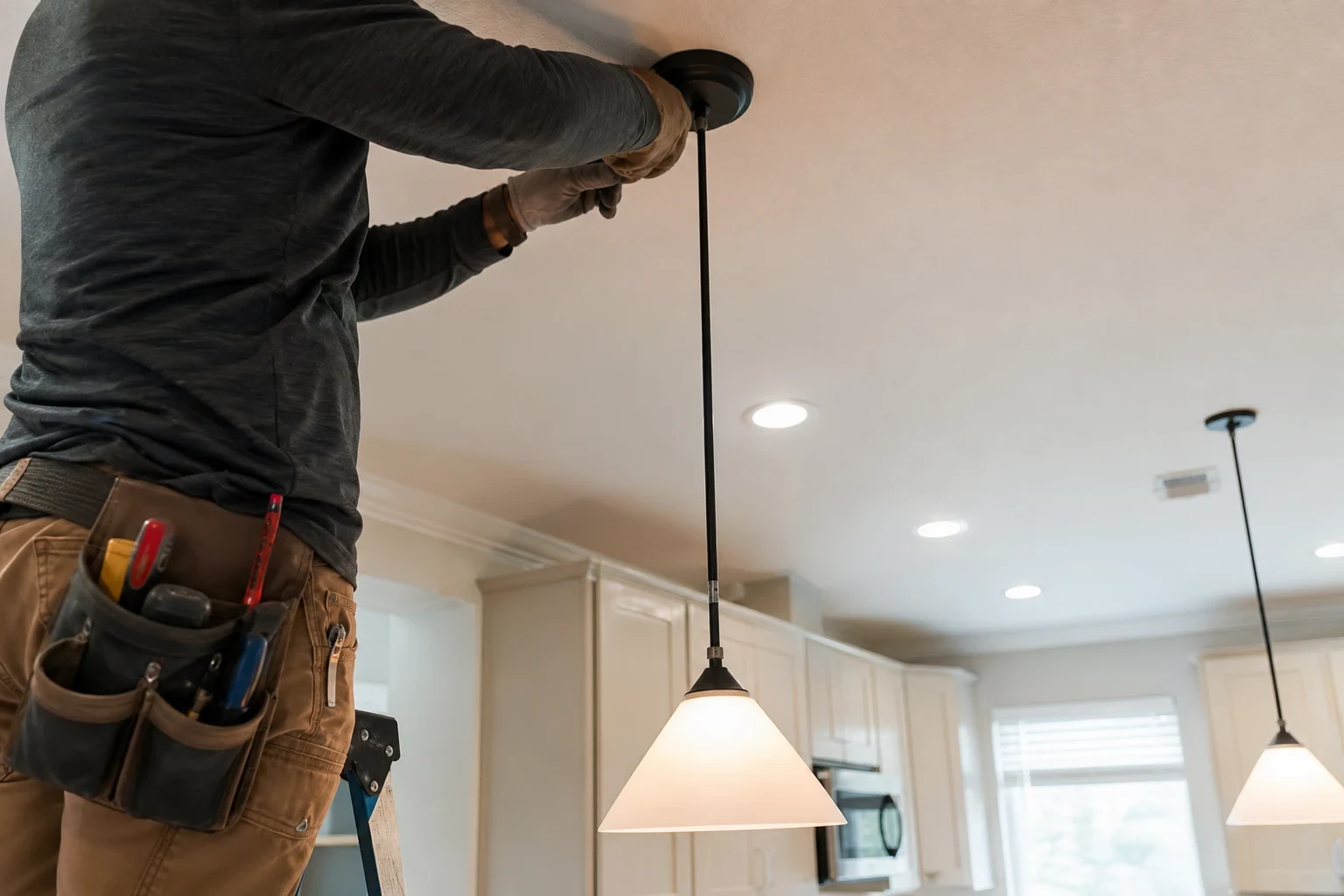
We confirm the ceiling box is rated for the fixture's weight, add bracing where it is not, and hang the fixture at a height that works over a table or island.
Under-cabinet and accent lighting
Low-profile LED strips or pucks with drivers tucked out of sight, wired to a wall switch rather than a tangle of plug-in cords.
Outdoor and security lighting
Porch, path and flood lights in weather-rated fixtures and boxes, on photocells, timers or motion sensors so they run only when they are useful.
Dimmers, sensors and smart controls
We match each dimmer to the LED fixture it controls, which prevents flicker and buzzing. Occupancy sensors suit laundry rooms, closets and garages where lights get left on.
LED retrofits
Where existing housings are sound, we fit LED trims or modules into them, so you get the lower draw without new ceiling holes.
Signs Your Lighting Needs Attention
- Bulbs burn out quickly
- Lamps that fail every few months often point to heat buildup in an enclosed fixture or a loose connection. Both are worth correcting, not just rebulbing.
- Flicker or buzzing on dimmers
- Older dimmers were made for incandescent loads. Paired with LEDs, they flicker, hum or will not dim smoothly.
- Hot fixtures and warm ceilings
- Halogen cans and old recessed lights can run hot enough to discolor trim. They also waste power as heat.
- Dark work areas
- Shadows on the counter or a dim stairway make a room harder and less safe to use.
- Outdoor lights on all day
- A failed photocell or a switch someone forgets keeps lights burning through daylight hours, quietly adding to your bill.
How a Lighting Visit Runs
- 1
Walk the space together
We look at the rooms, the existing switches and the attic or crawl access, and talk through how you use the space. You get a written scope that lists fixtures, controls and any new wiring.
- 2
Protect your home
On install day we lay drop cloths, cover furniture near the work and use dust control when cutting drywall. Power is shut off only to the circuits we are working on.
- 3
Wire, mount and test
We run cable through existing cavities where possible, make up connections in proper boxes and mount each fixture square to the ceiling. Then we test every switch, dimmer and sensor through its full range.
- 4
Finish and clean up
We patch small openings around our work, clear debris and vacuum. Before we leave, we show you how the controls work.
What Shapes the Cost of Lighting Installation
Most of the price comes from labor and access, not the fixtures themselves. A retrofit into existing boxes is quicker than running new cable to a ceiling with no wiring. We price from what we see on the walkthrough and explain each line before work starts.
- New wiring versus existing boxes
- Replacing a fixture on an existing box is straightforward. Adding lights or switches where none exist means fishing cable through walls and ceilings.
- Attic and ceiling access
- An open attic above makes recessed work faster. Finished floors above, vaulted ceilings or tight attic space take more time.
- Fixtures and controls
- You can supply fixtures or we can source them. Smart switches, sensors and specialty drivers add to the material cost.
- Circuit capacity
- If a circuit is already loaded, a large lighting addition may need a new circuit, and occasionally a look at the panel.
- Permits
- Some lighting work needs a permit and inspection, as required by the local jurisdiction. We handle that and include it in the estimate.
Lighting Installation Questions
- Can you replace my old recessed cans with LEDs?
- Usually, yes. If the housings are in good shape, an LED retrofit trim fits right in. If they are old non-airtight cans under the attic, we often recommend new sealed housings so you also stop the air leak.
- Will my existing dimmer switches work with LED lights?
- Often they will not work well. Many older dimmers cause flicker or a narrow dimming range with LEDs. We check each one and replace it with a dimmer rated for the fixtures it controls.
- Can you add a light where there is no switch or wiring now?
- Yes. We find a nearby power source, run new cable through the wall and ceiling, and add a switch where it makes sense to reach. Openings are kept small and patched.
- How long does a typical lighting project take?
- Swapping a few fixtures fits in part of a day. A full room of new recessed lights with switches typically takes a day, and larger projects across several rooms take longer. We give you a realistic schedule with the written scope.
- Do you install outdoor lighting?
- We do. We use weather-rated fixtures and boxes, seal the wall penetrations and add photocells, timers or motion sensors so the lights run only when needed.
Ready for Lighting That Works Harder and Costs Less
Tell us about the rooms you want to change, and we will set a time to look at them in person. You will leave the visit with a clear scope and an honest view of what each option saves.